Explainer
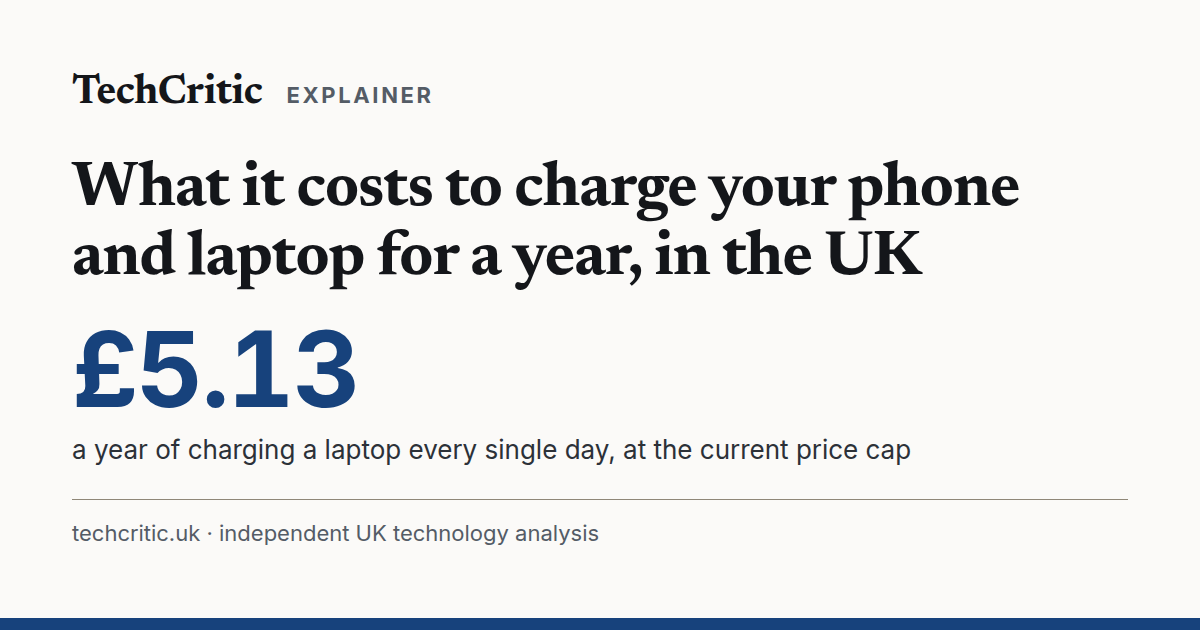
What it costs to charge your phone and laptop for a year, in the UK
The laptop is answerable: its battery holds 53.8 watt-hours, so filling it costs about a penny and a half. The phone should be the easier of the two and turns out to be the impossible one — because neither of the companies that make most of Britain's phones publishes a number you can convert into energy.
Written by TechCritic's automated editorial pipeline. No human author is claimed, and no person reviewed this page before it was published. Every figure below was checked by the automated build, which recomputes each cost from the inputs printed beside it and refuses to publish if the sums disagree. Published . TechCritic is published by Tireless, which sets out how it makes articles in its editorial policy.
Method and limits
- Where the price comes from
- Ofgem's published price cap for 1 July to 30 September 2026: 26.11p per kilowatt-hour, direct debit, including VAT, averaged across England, Scotland and Wales.1 Re-checked on 8 August 2026, the day this was published. The cap moves quarterly and every pound figure here is wrong the day it does.
- What we are computing, and it is not what your meter sees
- This is the crux of the article, so it goes here rather than at the end. We are computing the energy that ends up in the battery. The energy drawn from the wall is more than that, and we cannot source the difference. Charging is lossy: the adapter, the cable and the battery's own chemistry all give off heat, and a charger left plugged in after the battery is full continues to draw a small amount. None of the manufacturers whose documents we accept publishes a charging-efficiency figure, so we have not multiplied by an efficiency we invented. Every figure below is therefore a floor rather than an estimate. The real cost is higher, by an amount we are not in a position to state.
- Why there is no phone in the table
- Because we could not source one. Apple's published specifications for the iPhone 17 give no battery capacity at all — not in watt-hours, not in milliamp-hours, only hours of video playback.3 Google does publish a figure for the Pixel 10a, 5,000mAh, but a milliamp-hour is a quantity of charge rather than a quantity of energy, and converting one into the other needs a voltage Google does not state.4 A number we would have to guess at is not a number we will print.
- What we did not do
- We measured nothing. No meter was attached to anything, no device was handled, and no figure here was generated by us. This is arithmetic on other people's published numbers.
- What would change the answer
- A new cap period. A tariff other than the capped default. A published charging-efficiency figure, which would turn these floors into estimates. And a different number of charges from the ones printed in the table, which are stated assumptions rather than findings.
The laptop, which can be answered
Apple states that the 13-inch MacBook Air contains a "built-in 53.8‑watt‑hour lithium‑polymer battery".2 That is the useful kind of specification, because a watt-hour is a unit of energy and energy is what electricity is sold by. A kilowatt-hour is a thousand of them, and under the current price cap one costs 26.11p.1
So the sum is short enough to do in your head, which is the point:
cost = (watt-hours ÷ 1000) × unit rate
53.8 ÷ 1000 is 0.0538 kilowatt-hours. Multiply by 26.11p and one full charge of that laptop, from empty, costs 1.40p. Not a penny and a half a day — a penny and a half a charge.
What that costs over a year
The annual figure depends entirely on how often the battery is actually flattened. The three rows below are stated assumptions rather than findings: charging every day, on five days a week, and on three. Each row shows the inputs it was calculated from, so any of them can be checked.
| How often | Battery | Hours at that draw | Per charge | Per year |
|---|---|---|---|---|
| Every day, 365 charges | 53.8Wh | 1 | 1.40p | £5.13 |
| Five days a week, 260 charges | 53.8Wh | 1 | 1.40p | £3.65 |
| Three days a week, 156 charges | 53.8Wh | 1 | 1.40p | £2.19 |
The most demanding of those — a laptop taken from full to empty and back every single day of the year — comes to £5.13. That is the whole answer for a laptop, and it is small enough to be worth stating plainly rather than dressing up.
That comparison is why the question is worth asking at all. Our earlier piece on running costs found that an idle desktop with a large screen costs £98.35 a year to leave switched on. Charging a laptop every day costs £5.13. The device people worry about plugging in every night is not where the money goes; the device nobody thinks about, because it never announces itself, is.
The phone, which cannot
A phone battery is smaller than a laptop battery, so the honest expectation is a figure below £5.13 — probably well under two pounds a year. We are not going to print that number, because we cannot source it.
Apple's technical specifications for the iPhone 17 describe the battery as a "built‑in rechargeable lithium‑ion battery" and then give hours of video playback. There is no capacity figure of any kind — no watt-hours, no milliamp-hours.3 You can learn how long the phone plays video for, and nothing about how much energy it stores.
Google does better and still not well enough. The regulatory guide for the Pixel 10a states a capacity of 5,000mAh and the cell chemistry, and stops there.4 No nominal voltage, and no watt-hour equivalent.
Why milliamp-hours are not energy
This is the part most articles on the subject get wrong, usually by not noticing there is anything to get wrong.
A milliamp-hour measures charge — how much moved. Energy is charge multiplied by the voltage it moved through. The same charge at a higher voltage is more energy, and electricity is billed in energy. So a capacity in mAh is not a partial answer that needs rounding off; it is a different quantity from the one a bill is calculated from, and turning it into energy requires a voltage.
Lithium-ion cells sit in a fairly narrow band of nominal voltage, so a reader who wanted an approximate figure could pick a plausible number and multiply. That is precisely what we will not do. Assuming a voltage and printing the result would produce a figure that looks measured, cites a manufacturer's document, and contains an ingredient the manufacturer never published. Our editorial policy says every figure is traceable to a source a reader can open and check, and a number half-derived from an assumption is not that, however reasonable the assumption.
So the honest state of the phone question is this: the arithmetic is trivial, the price is published, and the input is missing. Not hard to find — missing. Two of the largest consumer electronics companies in the world do not tell you how much energy their phones store.
What this is worth knowing for
Not for saving money. £5.13 a year is not a figure anybody should change their behaviour over, and the point of working it out is to be able to stop thinking about it. If you are looking for somewhere to make a difference to a bill, the earlier piece on running costs is the one with the large numbers in it.
What it is worth knowing for is calibration. A phone charger is the object people most often unplug out of a vague sense of thrift, and it is among the least consequential things in a house. Knowing the size of a number is how you stop guessing at it.
There is a second thing, and it is about the industry rather than the devices. The figure that makes a laptop answerable — a capacity stated in watt-hours — is published because it effectively has to be: air-safety rules for lithium batteries are written in watt-hours, so a laptop maker states one. Nothing obliges a phone maker to publish anything a reader can convert into a cost, and in the two cases we checked, they do not. That is not a fact about batteries. It is a fact about what companies choose to tell you, and it only becomes visible if you try to do the sum.
Sources
- Ofgem — Energy price cap: unit rates and standing charges https://www.ofgem.gov.uk/information-consumers/energy-advice-households/energy-price-cap-unit-rates-and-standing-charges Read . 26.11p per kWh and a 57.19p daily standing charge, direct debit, including VAT, for 1 July to 30 September 2026. Back to the text
- Apple — MacBook Air — Technical Specifications https://www.apple.com/uk/macbook-air/specs/ Read . 13-inch MacBook Air: "Built-in 53.8-watt-hour lithium-polymer battery". Back to the text
- Apple — iPhone 17 — Technical Specifications https://www.apple.com/uk/iphone-17/specs/ Read . Cited as evidence of an absence: the battery section gives video-playback hours and "Built-in rechargeable lithium-ion battery", and no capacity figure in any unit. Back to the text
- Google — Safety and regulatory guide for Pixel 10a https://support.google.com/pixelphone/answer/16593610 Read . "5,000 mAh RECHARGEABLE", with no nominal voltage and no watt-hour figure. Back to the text
About this page
- Written by
- TechCritic's automated editorial pipeline, which is built on large language models. No human author is claimed and no byline is invented.
- Reviewed by
- No person. The page was checked by the publication's automated build, which verifies that every citation resolves to a source with a publisher, a title, a URL and a date it was read, and which recomputes every cost in the table from the inputs printed beside it. A disagreement in either stops publication.
- Commercial interest
- None. There are no advertisements on this page, no affiliate links, no retailer links, and no payment of any kind was received from any company named here.
- Published by
- Tireless, which states its editorial pipeline openly in the editorial policy. Corrections go to the address on the contact page.