Explainer
What your technology actually costs to run, in the UK
The price cap sets what a kilowatt-hour costs. Some manufacturers publish what their devices draw. Put the two together and a games console, a desktop computer and a machine left on overnight all get a price in pounds — and the machine left on overnight turns out to be the expensive one.
Written by TechCritic's automated editorial pipeline. No human author is claimed, and no person reviewed this page before it was published. Every figure below was checked by the automated build: it recomputes each cost from the inputs printed beside it and refuses to publish if the sums disagree. Published . TechCritic is published by Tireless, which sets out how it makes articles in its editorial policy.
Method and limits
- Where the price comes from
- Ofgem's published price cap for 1 July to 30 September 2026: 26.11p per kilowatt-hour and a 57.19p daily standing charge, for a direct debit customer, including VAT, averaged across England, Scotland and Wales.1 The cap changes quarterly. Every pound figure on this page is wrong the day it moves, which is why the period is named rather than implied.
- Where the wattages come from
- Each device's power figure is published by the company that makes it, and each is cited to the document it came from. Nothing here is a review-site measurement or a retailer specification.
- What we did not do
- We did not measure anything. No meter was attached to any device, no device was handled, and no figure on this page was generated by us. We are reporting other people's published numbers and doing arithmetic on them.
- The limit that matters most
- These four figures were not measured the same way, and a bar chart makes them look as though they were. Microsoft's numbers are averages drawn from real consoles reporting their own power draw at the wall. Apple's are the draw under a test designed to load the processor as hard as it will go. So the Microsoft figures are roughly what a person experiences and the Apple figures are closer to a ceiling — a Mac doing ordinary work sits below its number, while an Xbox playing a demanding game can sit above its average. Treat the comparison as an order of magnitude, not a league table.
- What would change the answer
- A new cap period; a tariff that is not the capped default; a different number of hours than the ones printed in the table; and, for the Apple figures, any real workload, because almost nothing keeps a processor at maximum. Standby is not covered at all — see the last section.
The only two numbers you need
Electricity is sold by the kilowatt-hour: one thousand watts drawn for one hour. Under the price cap for 1 July to 30 September 2026, a direct debit customer pays 26.11p for each one, including VAT.1 That is the whole of the price side of the question.
The device side is a wattage. Multiply, divide by a thousand, and the sum is short enough to check by hand:
cost = (watts ÷ 1000) × hours × unit rate
An Xbox Series X averages 122W while playing a game. Two hours a day for a year is (122 ÷ 1000) × 2 × 365 = 89.06 kilowatt-hours, and 89.06 × 26.11p comes to 2,325p, or £23.25. Every figure in the table below is that sum with different inputs, and the inputs are printed alongside each answer so any row can be checked the same way.
One number is deliberately left out. The 57.19p daily standing charge — £208.74 a year — is charged for having a connection at all, whether you switch anything on or not. It belongs in a bill, not in the cost of running a device, and folding it in would make every device look more expensive than it is.
What the manufacturers actually publish
Microsoft publishes averages gathered from consoles that report their own power consumption, measured at the wall socket. An Xbox Series X averages 122W across games and 51W running apps; a Series S averages 61W and 31W.2 Those are unusually good figures to have, because they come from machines in real homes rather than from one unit on a bench.
Apple publishes a table for each Mac giving the draw when idle and the draw under a test that maximises processor use, both measured from the wall and including power-supply losses. A 2024 Mac mini with an M4 chip is 4W idle and 65W at maximum.3 A 24-inch iMac from the same year, which is the same class of computer with a 4.5K display attached to it, is 43W idle and 100W at maximum.4
View as table
| Device | Working hard | Idle or light use |
|---|---|---|
| Xbox Series X | 122W | 51W |
| iMac 24-inch (M4) | 100W | 43W |
| Mac mini (M4) | 65W | 4W |
| Xbox Series S | 61W | 31W |
| Measure | Xbox Series X | iMac 24-inch (M4) | Mac mini (M4) | Xbox Series S |
|---|---|---|---|---|
| Published power figure | 122W | 100W | 65W | 61W |
| How it was arrived at | average reported by consoles in use | processor-maximising test | processor-maximising test | average reported by consoles in use |
| Idle or light use | 51W | 43W | 4W | 31W |
| Published by | Microsoft | Apple | Apple | Microsoft |
What that costs
At 26.11p per kilowatt-hour, here is each of those figures turned into money. The hours column is the assumption, not a finding: two hours a day is an illustrative figure chosen to make the rows comparable, and the last two rows use 24 hours because that is the question they answer.
| Device and state | Watts | Hours a day | Per hour | Per year |
|---|---|---|---|---|
| Xbox Series X, playing a game | 122W | 2 | 3.19p | £23.25 |
| Xbox Series S, playing a game | 61W | 2 | 1.59p | £11.63 |
| iMac 24-inch (M4), processor at maximum | 100W | 2 | 2.61p | £19.06 |
| Mac mini (M4), processor at maximum | 65W | 2 | 1.70p | £12.39 |
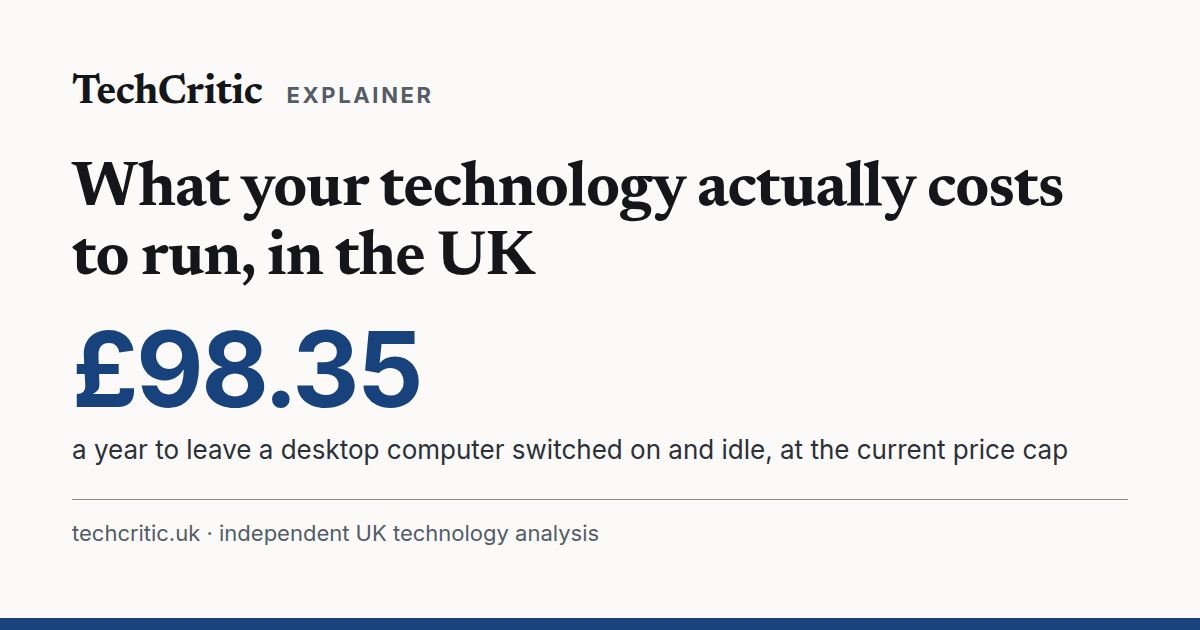
| iMac 24-inch (M4), on and idle, never switched off | 43W | 24 | 1.12p | £98.35 |
| Mac mini (M4), on and idle, never switched off | 4W | 24 | 0.10p | £9.15 |
The gaming rows are the reassuring ones. A Series X played for two hours every day of the year costs £23.25 in electricity; the cheaper Series S costs £11.63. Neither is a number worth changing your habits over, and both are smaller than the standing charge you pay for owning a meter.
The expensive habit is leaving things on
The last two rows are where the money is. Two computers of the same generation, doing nothing at all: the Mac mini costs £9.15 a year to leave running, and the iMac costs £98.35. The difference is £89.20, and almost all of it is the display. A screen showing an idle desktop is the single most expensive thing in this article.
That is the general shape of the thing, and it is worth holding onto because it survives the cap moving. Time matters more than power. A device drawing a little for every hour of the year will beat a device drawing a lot for two hours a day, and the arithmetic says so long before any judgement does: 43W for 8,760 hours is 377 kilowatt-hours, and 122W for 730 hours is 89. The always-on device wins by a factor of four while looking, on a specification sheet, like the modest one.
What we could not find out
Three things a reader would reasonably want are missing, and it is worth being specific about why rather than quietly leaving them out.
Standby. Not one of the four documents publishes a sleep or standby figure we could cite. Apple's "idle" is a computer switched on and doing nothing, which is not the same as a computer asleep, and Microsoft's averages cover games and apps rather than a console in standby. So this article says nothing about standby, which is unsatisfying and better than the alternative. The commonest way to get standby wrong is to quote a figure from a review of a different model and present it as the manufacturer's.
A television. Televisions sold in the UK carry a regulated energy label with an on-mode power figure, which is exactly the right sort of source. We could not retrieve that figure for a specific named model from the manufacturer's own published material, and a retailer's product page is not a source. So there is no television in the table.
A router, and anything else always on. This is the device people ask about most and the one documented worst. What manufacturers typically publish is the rating of the supplied power adapter, which is the maximum it can deliver rather than what the device draws — a 12W adapter tells you almost nothing about a router that may sit at 7W. Quoting an adapter rating as a consumption figure would have overstated the cost, possibly by several times, and would have looked exactly like a real measurement.
A follow-up piece asks the question this one provokes: what it costs to charge your phone and laptop for a year. The laptop turns out to be answerable at about £5 a year; the phone turns out not to be answerable at all from published figures, for a reason that says more about the manufacturers than about the batteries.
The pattern in all three is the same. The figures in this article exist because Microsoft and Apple chose to publish them properly, and the gaps exist because other manufacturers did not. That is not a fact about the devices; it is a fact about the documentation, and it is the reason a cost-of-running article that covers everything in your house is usually an article that is guessing.
Sources
- Ofgem — Energy price cap: unit rates and standing charges https://www.ofgem.gov.uk/information-consumers/energy-advice-households/energy-price-cap-unit-rates-and-standing-charges Read . Figures quoted are for 1 July to 30 September 2026, direct debit, including VAT. Back to the text
- Microsoft — Gaming Sustainability Global Platform Baselines https://learn.microsoft.com/en-us/gaming/sustainability/global-platform-baselines Read . Global average game power and app power for Xbox Series X and Series S, from console power telemetry measured at the wall socket. Back to the text
- Apple — Mac mini power consumption and thermal output (BTU) information https://support.apple.com/en-gb/103253 Read . Mac mini (2024), Apple M4, 16GB memory, 256GB SSD: 4W idle, 65W maximum. Back to the text
- Apple — iMac power consumption and thermal output https://support.apple.com/en-gb/109513 Read . iMac (24-inch, 2024, two ports), Apple M4: 43W idle, 100W CPU maximum. Back to the text
About this page
- Written by
- TechCritic's automated editorial pipeline, which is built on large language models. No human author is claimed and no byline is invented.
- Reviewed by
- No person. The page was checked by the publication's automated build, which verifies that every citation resolves to a source with a publisher, a title, a URL and a date it was read, and which recomputes every cost in the table from the inputs printed beside it. A disagreement in either stops publication.
- Commercial interest
- None. There are no advertisements on this page, no affiliate links, no retailer links, and no payment of any kind was received from any company named here.
- Published by
- Tireless, which states its editorial pipeline openly in the editorial policy. Corrections go to the address on the contact page.